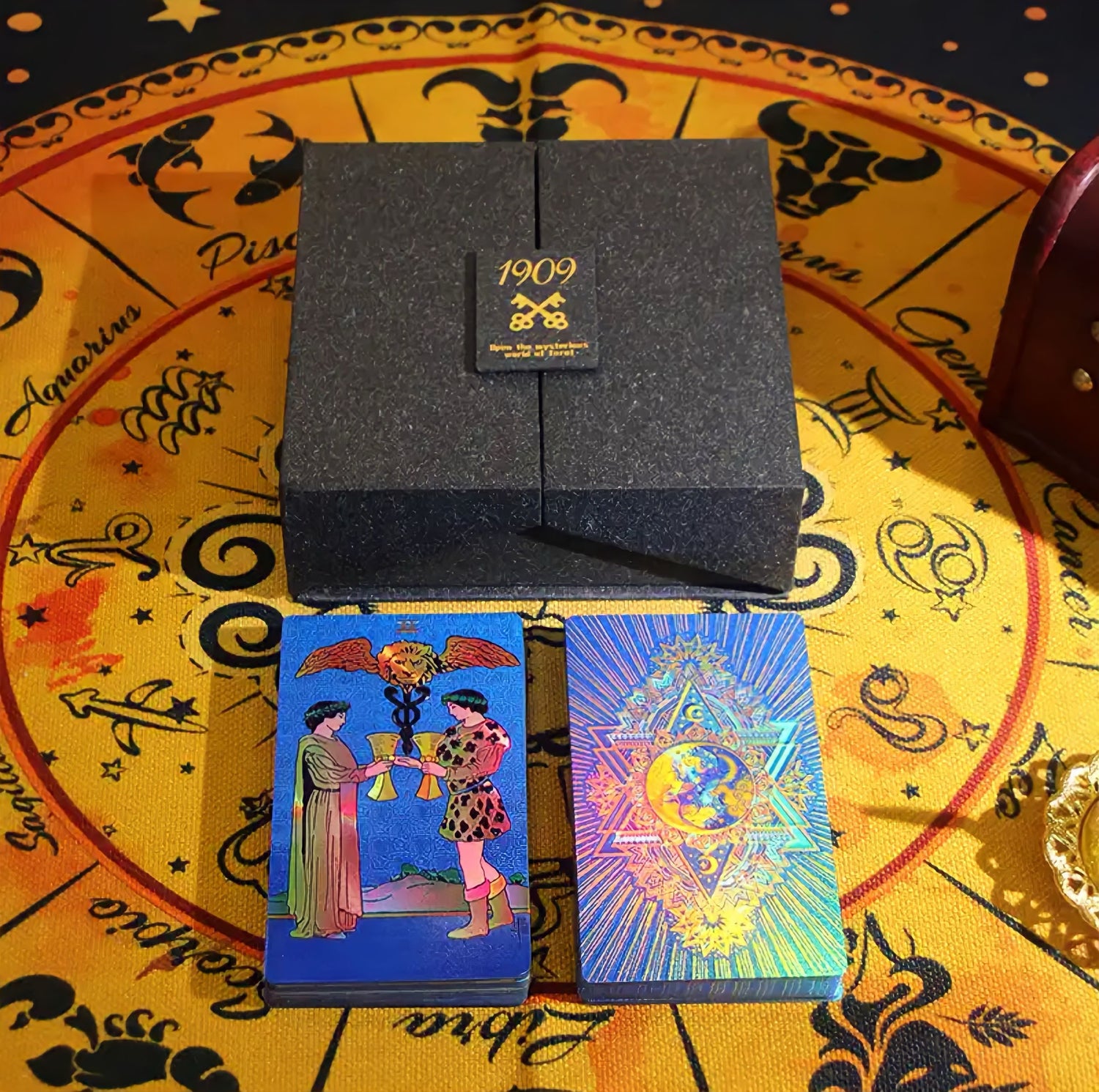

Look closely at almost any tarot deck and you'll notice how much of the storytelling happens in the sky. Some cards are painted under flat, cloudless blue. Others have grey banks of cloud pressing down on the figures. One card has rain falling on someone who hasn't looked up yet. Most readers learn the figures and the objects first and never really notice the weather, which is a shame, because the weather is often where the emotional temperature of a card lives.
I started paying attention to this during a February when I felt inexplicably flat. Every card I pulled that month seemed to have a heavy sky, and eventually I realized I was reading my own atmosphere into perfectly ordinary illustrations. That's not a failure of technique. That's the whole mechanism working.

Weather as emotional shorthand
We already use weather to describe feelings, constantly and without thinking. Someone is under a cloud. A mood clears. There's an atmosphere in the room. A relationship is stormy. This isn't decoration; it's how human beings talk about inner states that resist plain description.
Tarot imagery leans on the same instinct. When you notice the sky in a card, you're tapping a symbolic language you're already fluent in.
Clear skies
An open, empty sky can read as relief, clarity, and possibility. It can also read as exposure. There's nowhere to hide under a cloudless sky, and no shade. If you pull a card with a wide bright sky during a week when you feel scrutinized at work, that second reading may be the honest one.
Clouds
Clouds rarely mean disaster. They usually mean something is forming and you can't see its shape yet. That's uncomfortable, but it's a normal stage of anything real. Ask yourself: is this a cloud of dread, or a cloud of not-yet-knowing? They feel similar in the body and they call for different responses.
Rain
Rain in card imagery often sits alongside grief, release, and the end of holding something in. Rain is also how things get watered. If you're in a season of crying more easily than usual, a rain-heavy card may simply be naming that accurately.
Wind
Wind is movement you can't control and can't stop. It shows up around news, gossip, change arriving from outside. Wind cards are good prompts for asking what I can steady rather than what I can prevent.
Heat and low sun
A heavy, hot sky suggests effort, endurance, and the exhaustion of pushing through. A low or setting sun suggests a chapter closing, or the particular tenderness of late afternoon.
How to use this in an actual reading
Try this small practice. Pull three cards for the current stretch of your life, and before interpreting anything else, describe only the weather in each image, out loud or on paper. "Overcast. Bright but windy. Rain just stopping."
Then ask: does that sequence describe my last three weeks?
Most of the time it will, somewhat unnervingly. Not because the cards knew, but because you selected what you noticed. Your attention is doing the work, and the images are giving it somewhere to go.
A reflective exercise for a low season
If you've been flat or anxious for a while, lay out five cards and sort them by sky rather than by suit or number. Put the bright ones in one pile, the heavy ones in another. Then look at the bright pile and ask what in my life currently looks like this? People in low seasons genuinely struggle to recall the good parts without a prompt. This is a prompt.
Real weather counts too
There's a practical layer here worth respecting. Light, season, and weather affect mood in ordinary, physical ways. If your readings turn consistently heavy every November and lift in March, the most useful interpretation might involve daylight, sleep, and getting outside before noon, not symbolism at all. Tarot can point you toward that observation, and then a doctor or therapist is the right person for what follows. Persistent low mood deserves real care, not just a good reading.
Keeping it grounded
The sky in a card is not a forecast, for the weather or for your life. It's an invitation to name an atmosphere you're already living in. That naming is the value. A person who can say "I've been under cloud for two weeks and I think it's about my job" has something workable. A person who just feels vaguely wrong does not.
A gentle invitation
For the next two weeks, write down one card a day and only the weather in it, plus three words about your own mood. No interpretations. When you read the two columns together at the end, you'll have a small, honest map of your emotional climate, drawn in a language you already knew how to read.


