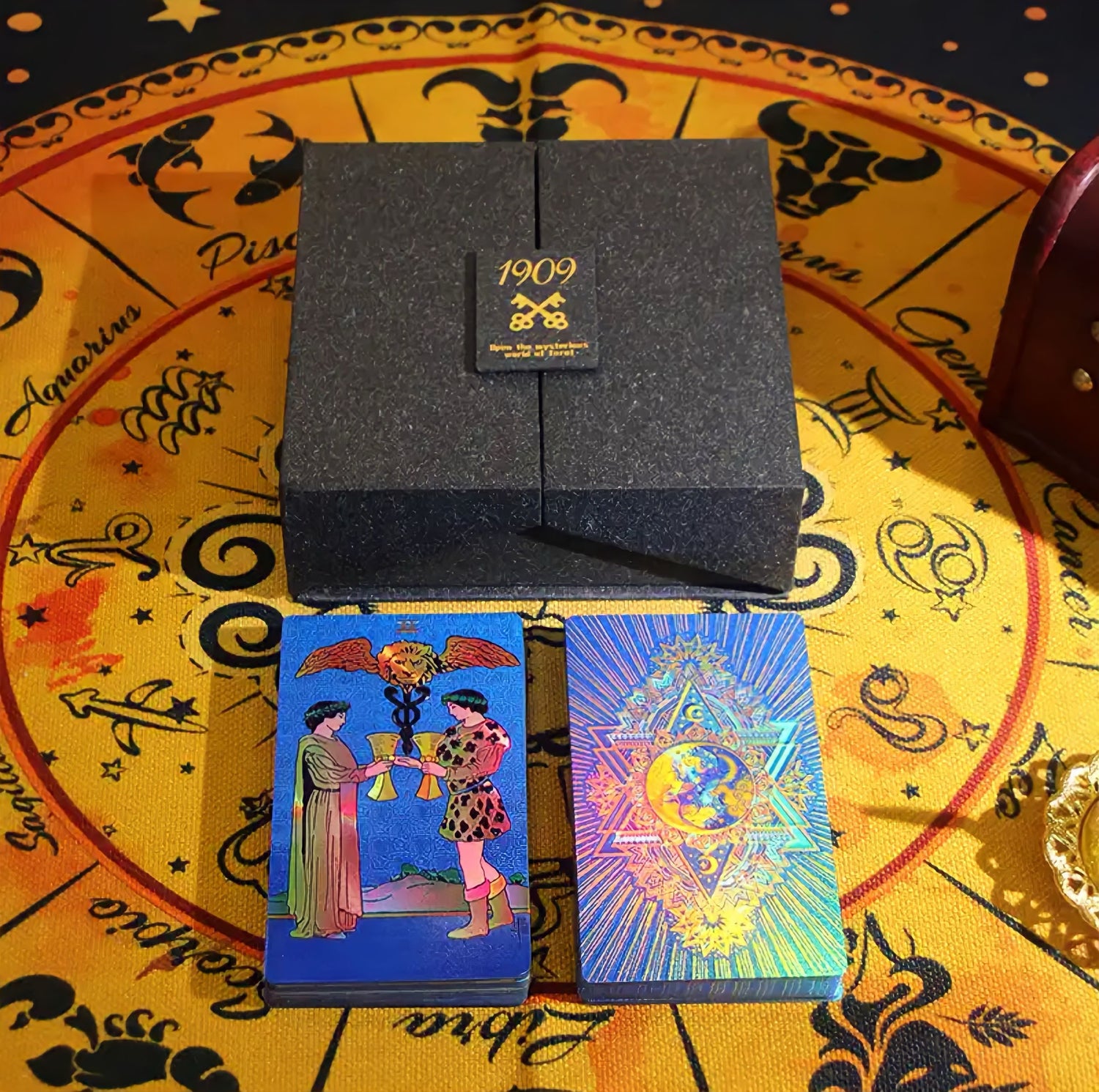


There is a particular kind of tiredness that comes with small children, and it has very little to do with sleep. It's the tiredness of never finishing a thought. You start to consider how you feel about something and then someone needs a snack, a bandage, or your urgent opinion on a truck. For years I believed my tarot practice had simply ended when my first child was born. What actually happened was quieter than that: my practice stopped fitting the shape I had built for it.
Most tarot advice assumes an evening, a candle, and silence. Parents of toddlers have none of those things reliably. But tarot is not a ceremony that requires perfect conditions. It's a reflective tool, a way of putting a symbol in front of yourself so your own thoughts have something to press against. That works in thirty seconds at a kitchen counter just as well as it works at midnight.

Why the old format stops working
A traditional reading asks you to settle, shuffle, lay out several cards, and interpret them in relation to one another. That sequence needs continuity. With a toddler nearby, continuity is the one resource you cannot count on. So instead of grieving the format, it helps to change what you ask of the cards.
During these years, I stopped asking tarot for direction and started asking it for language. I didn't need to know what to do next. I needed a word for the thing I was feeling at 7:40 in the morning while holding a shoe.
The one-card check-in, done honestly
Pull a single card. Don't look up a meaning. Look at the picture for the length of one breath and ask yourself only this: what in this image matches my morning?
Say you draw a card showing a figure carrying far too many objects at once. You don't need a formal interpretation to recognize yourself. The useful part is the follow-up question: which of these things is actually mine to carry today, and which did I pick up out of habit? That's a two-minute reflection with a real result. Maybe you decide the laundry waits. Maybe you decide the group chat waits.
A card showing still water might land on a day when you've been loud and reactive since dawn. A card showing a busy marketplace might land on a day when you've been alone in the house with a two-year-old and are starved for adult conversation. Tarot isn't telling you these things. It's giving your own noticing somewhere to land.
Where the cards can live
Practicality matters more than atmosphere here. Keep a deck somewhere that survives your actual life, a high kitchen shelf, a drawer by the kettle, the pocket of your bag. Some parents keep a smaller travel deck precisely because it can be pulled out at a playground bench.
Sticky little rituals work better than beautiful ones. Pull a card while the kettle boils. Pull one while you wait in the school pickup line. Pull one after bedtime, before the phone comes out. The consistency is what builds insight over months, not the candle.
Reading about your child, carefully
Parents often want to pull cards about a child, usually out of love and worry. This is worth doing gently, and worth being clear about what you're doing. A card cannot tell you what is happening inside your child, whether a behavior is a phase, or whether something needs professional attention. If you're worried about development, sleep, eating, or mood, that's a conversation for a pediatrician or a qualified therapist, not a card.
What tarot can do is surface your side of the dynamic. Try a two-card reflection: one card for what I'm bringing to this relationship right now, one for what I might be missing. I once drew a card showing a figure standing guard over a wall and realized I had been managing my daughter rather than enjoying her. The card didn't diagnose anything. It just made me put words to a drift I'd felt for weeks.
A short spread for a hard week
When you do get twenty quiet minutes, this three-card layout is worth the time.
1. What is actually depleting me
Not the obvious answer. The real one.
2. What I'm still getting right
Parents are very bad at seeing this unaided.
3. One small thing I can change this week
Small enough to be true.
Reflective questions to sit with afterward: When did I last feel like myself, and what was I doing? What am I doing out of guilt rather than need? Who could I ask for help that I haven't asked?
Keeping it honest
Tarot in this season is best treated as a mirror and a vocabulary, not a forecast. It won't tell you whether your kid will sleep through the night, and any reading that claims to is selling certainty that doesn't exist. It isn't medical, psychological, or parenting advice either. What it will do is interrupt autopilot, which is exactly the thing that thins out during the toddler years.
Some days the card will mean nothing to you. That's fine. A practice that survives your real life will have dull days in it. The point is that it survives.
A gentle invitation
If your practice has gone quiet since your children arrived, try one week of single cards pulled at the most chaotic point of your day rather than the calmest. Write one sentence about each in a notebook you keep in the kitchen. At the end of the week, read the seven sentences together. You may find they describe your season more accurately than anything else you've managed to record.


